‘ As we look at the largest spaces and the smallest elements, we try to find a reflection of ourselves. ’
The Cloud
permanent public artwork — 2024
architecture
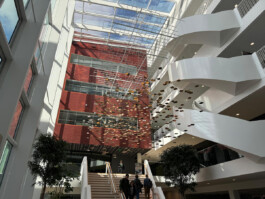
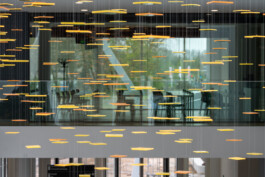
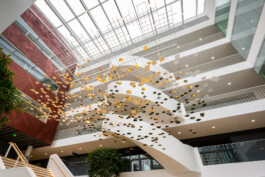
The Cloud is installed in the atrium of the Gorlaeus Building of the Faculty of Science, Leiden University. Researchers, students and visitors flow in and out the building and move in three dimensions. The Cloud fills the atrium with colour and reflection. I can only hope that sometimes we look in the mirror here and encounter ourselves, but especially each other.
Both artists and scientists use their intuition, imagination and creativity. I kept this in mind during the design process. — Faculty of Science, Leiden University
Faculty of Science, Leiden University website, april 2024:
Creating a work of art for a university building was a new endeavor for Agasi. He drew inspiration from the research environment in conceptualising the piece. ‘Scientists and artists have more in common than we think. Although the methods of work and conceptualisation of new knowledge and strategies vary, both artists and scientists use their intuition, imagination and creativity. I kept this in mind during the design process.’
With this art installation, Agasi wanted to contemplate how we can represent the vast amount of data and knowledge we find, collect and produce in science. To visualise the concept of data, he chose a form that can be seen as a point cloud, a series of data points in space. He designed the cloud to be abstract so that anyone can identify with it in any conceivable way. After all, looking at scientific data and making sense of it can indeed be an intuitive and personal process.


Unveiling of the artwork by Meta Knol – art historian, curator, former director of Leiden City of Science, former director of Museum De Lakenhal. Leiden, 15 April 2024 (excerpt):

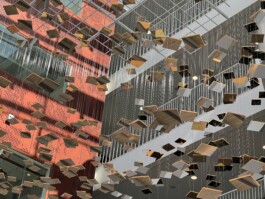
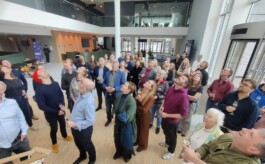
Jos Agasi moved from being a video art pioneer, perfecting his skills, to an independent artist, with an increasing engagement with the world around him – see project VLOED. A Leiden influence, De Stijl, can be found in early topographical work, and now again in the autonomy Jos demonstrates in exploring visual means and penetrating abstract facets of reality. This is the result. (...) Light is sometimes captured, sometimes diffused: the interstice he creates with it is the most exciting. (...) The work enters into a symbolic relationship with the environment. The mirrors refer to ourselves, our capacity for self-reflection, which allows us to better understand the world. (...) Jos ‘sees through’ reality, in the discovered interstice. He does this in a way that I sometimes think only artists can. (...) Let us now look up for 23 seconds.
Find out more about how the artwork was created, designed and constructed with a team of great people: see Making of The Cloud.
‘ As we look at the largest spaces and the smallest elements, we try to find a reflection of ourselves. ’
The Cloud
permanent public artwork — 2024
architecture
The Cloud is installed in the atrium of the Gorlaeus Building of the Faculty of Science, Leiden University. Researchers, students and visitors flow in and out the building and move in three dimensions. The Cloud fills the atrium with colour and reflection. I can only hope that sometimes we look in the mirror here and encounter ourselves, but especially each other.
Both artists and scientists use their intuition, imagination and creativity. I kept this in mind during the design process. — Faculty of Science, Leiden University
Faculty of Science, Leiden University website, april 2024:
Creating a work of art for a university building was a new endeavor for Agasi. He drew inspiration from the research environment in conceptualising the piece. ‘Scientists and artists have more in common than we think. Although the methods of work and conceptualisation of new knowledge and strategies vary, both artists and scientists use their intuition, imagination and creativity. I kept this in mind during the design process.’
With this art installation, Agasi wanted to contemplate how we can represent the vast amount of data and knowledge we find, collect and produce in science. To visualise the concept of data, he chose a form that can be seen as a point cloud, a series of data points in space. He designed the cloud to be abstract so that anyone can identify with it in any conceivable way. After all, looking at scientific data and making sense of it can indeed be an intuitive and personal process.


Unveiling of the artwork by Meta Knol – art historian, curator, former director of Leiden City of Science, former director of Museum De Lakenhal. Leiden, 15 April 2024 (excerpt):

Jos Agasi moved from being a video art pioneer, perfecting his skills, to an independent artist, with an increasing engagement with the world around him – see project VLOED. A Leiden influence, De Stijl, can be found in early topographical work, and now again in the autonomy Jos demonstrates in exploring visual means and penetrating abstract facets of reality. This is the result. (...) Light is sometimes captured, sometimes diffused: the interstice he creates with it is the most exciting. (...) The work enters into a symbolic relationship with the environment. The mirrors refer to ourselves, our capacity for self-reflection, which allows us to better understand the world. (...) Jos ‘sees through’ reality, in the discovered interstice. He does this in a way that I sometimes think only artists can. (...) Let us now look up for 23 seconds.
Find out more about how the artwork was created, designed and constructed with a team of great people: see Making of The Cloud.